Fig. 1 Stress fracturing and a bolt exposed on an advance face in a cut-and-fill mine stope. Note the locus of the stress-induced fractures
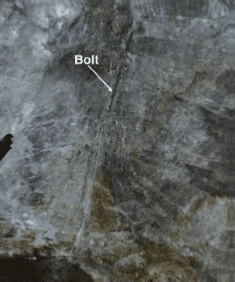
Fig. 2 A rebar bolt exposed on the advance face of a cut-and-fill mine stope. The bolt was subject to shear loads and deviated from its original hole trace. The thick arrows point the direction of possible shear movements in the rock
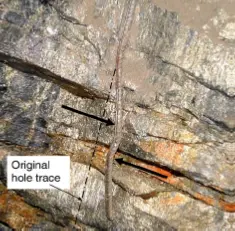
Fig. 3 A failed rebar bolt exposed on the advance face of a cut-and-fill mine stope. The bolt was subject to both pull and shear loads prior to failure. The axial opening displacement was about 30 mm and the lateral displacement was about 18 mm at the position of failure
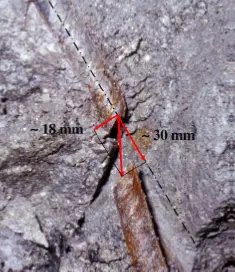
Fig. 4 Shear failure of rock bolts in situ. The failed rebar bolts exposed on an advance face in a metal mine in Sweden. Bolt 1 failed at about 1.5 m from the face plate and bolt 2 at about 0.5 m. The arrows point the movement direction of the rock in the positions of the bolt failure. Bolt 1 has been offset by about 40 mm and the opening displacement is at least 20 mm. a The two failed bolts on the face. b Close-up of Bolt 1. c Close-up of Bolt 2
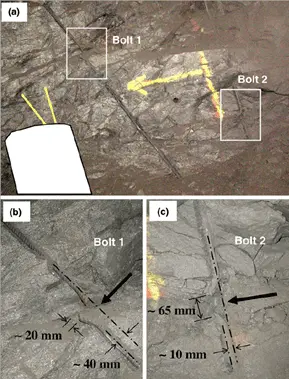
Fig. 5 Failed rock bolts. a A failed rebar bolt in a creeping rock mass, Sweden. b Failed split sets in a weak rock mass, Australia
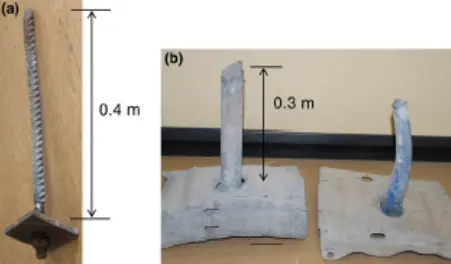
Fig. 6 Failed rebar bolts and two cone bolts exposed after a roof fall induced by a mine tremor in a metal mine
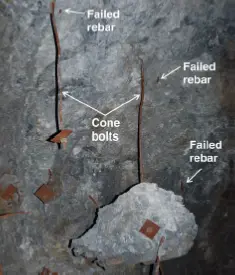
Fig. 7 Cone bolts and rebar bolts tested in a heavily deformed mine drift in Canada. a A rebar that sank into the rock. b A failed rebar and an un-damaged cone bolt. c A cone bolt that lost its exterior anchoring point at the face plate
Conclusions
l In situ rock bolts are most loaded in the portion close to the collar of the borehole. In a dilating rock mass the maximum bolt load usually occurs at a distance of about 0.5 m from the face plate.
l Rock bolts are subject to both pull and shear loads in situ. The shear strength of a rock bolt is equally important as its tensile strength.
l The major shortcoming of the conventional fully bonded rebar bolt is its small deformation capacity. A small amount of fracture opening would result in premature failure of the bolt because the deformation capacity of the bolt material is mobilised only in a small bolt segment overriding the fracture.
l In high-stress rock conditions, rock bolts should not only have a high load-bearing capacity, but also should be able to accommodate large rock dilations. In other words, they should be able to absorb a large amount of energy prior to failure.